healthslips.com.au Pty Ltd (healthslips.com.au) has partnered with ItsMy Group Pty Ltd (ItsMy Group) for the provision of health insurance products. By proceeding, you agree that ItsMy Group will use your personal information for the purposes of providing advice to you on health insurance products and assisting you with arranging cover if you decide to proceed with a purchase. Not all policies can be discussed or purchased over the phone. If you click 'Talk to an expert' and our specialists cannot assist with your preferred policy, they will tell you and offer to discuss alternatives or provide you with contact details for your preferred policy.
ItsMy Group and healthslips.com.au will collect, store and use your information in accordance with the ItsMy Group Privacy Policy and the healthslips.com.au Privacy Policy.
The ItsMy Group is a signatory to the Private Health Insurance Intermediaries Code of Conduct.
If you’re in a relationship, you might be wondering whether you can get more value from your health insurance by combining cover with your partner. Or perhaps your children have left home and moved onto their own health insurance policies, so you’re considering changing from a Family to a Couples policy. Either way, you’ll want to find the best health insurance for couples in Australia.
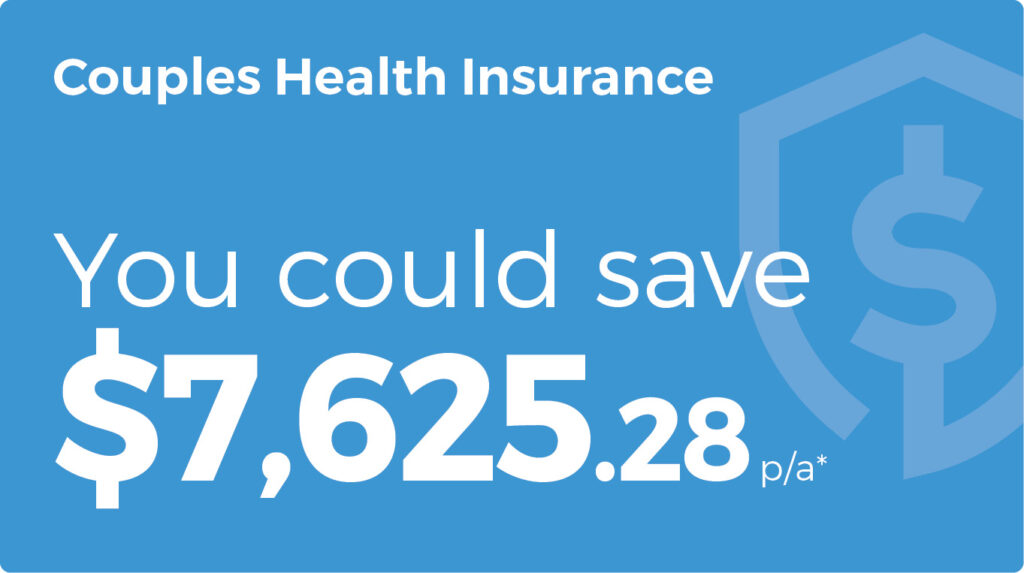
Using the healthslips.com.au calculator to find the right Couples policy for you could really pay off – our calculations found a difference of around $7,625.28 a year between the cheapest and most expensive Silver tier Combined Hospital and Extras policies for a couple in Victoria. And with the cost of health insurance rising, now is the time to shop around and make sure you’re getting the best deal. (Tip: you can do this easily by using our calculator, which compares every policy in the market, and you don’t need to enter your contact details to get your results.)
To find the best private health insurance for couples, here’s what you need to consider.
*Difference between cheapest and most expensive Silver tier Combined Hospital and Extras policies, 2 adults, Victoria. Calculated April 2026.
Do I need to share health insurance with my partner?
A couples health insurance policy is a shared policy between 2 people, and you don’t have to be married to be eligible but you do need to be living together. The main advantage of a Couples health insurance policy is the convenience of paying for one policy rather than managing 2 separate policies.
You won’t typically save money on premiums with a Couples policy, but you may be able to share your benefit limits, which is helpful if one person’s need for a particular health service is greater than their partner’s, for example dental care needs.
If you’re a young couple, getting health insurance could be a good idea – especially if you’re planning to start a family in the near future. Hospital Cover means you’re covered for Pregnancy and Birth (if you choose the right level of cover), but there’s usually a 12-month waiting period, so you need to take out the policy before you’re ready for kids. It’s best to upgrade to a Family policy before your baby is born, to make sure they’re covered from birth.
Don’t forget about the financial benefits, either. Getting health insurance as a young couple could save you money in the future, thanks to the Age-based Discount which some insurers offer and applies to anyone who takes out Hospital Cover before age 30 and maintains it. For couples, the Discount is calculated as an average between the 2 of you, like in this example:
Jacob aged 26, Olivia aged 32
Jacob gets an 8% discount due to being 26 years old, but his partner Olivia is 32 and therefore ineligible. The Age-based Discount on their couples policy would be 4%, the average between 8% and 0%.
And regardless of your relationship status, taking out a policy now will also help you avoid the Lifetime Health Cover Loading, which applies to anyone taking out health insurance for the first time after age 31.
Do older couples need health insurance?
As we age, our healthcare needs increase so private health insurance can really pay off in your senior years. You and your partner could take out a policy for 2 adults where you can share your limits and manage one policy, or if you have different healthcare needs, you could get 2 single policies at different tiers, which may save you money.
What happens to the Lifetime Health Cover Loading on a couples policy?
On a policy for 2 adults, if both of you took out Hospital Cover before the age of 31 and have maintained it continually, you don’t need to pay the Lifetime Health Cover Loading (LHCL).
LHCL is calculated at an extra 2% for every year older than the age of 31 you are when taking out Hospital Cover for the first time. If one, or both, of you need to pay the Loading, here’s how it’s calculated:
If both people in the relationship have to pay the Lifetime Health Cover Loading, the percentage will be added together. For example, Mike is 41 and his wife Bhavani is 37. Both are taking out health insurance for the first time, so Mike has 22% Loading and Bhavani has 14%. That Loading is averaged out so that their couples policy will cost them an extra 18% in Loading.
If one person has to pay the Lifetime Health Cover Loading but the other doesn’t, the percentage of Loading is still averaged across both people. For example, if Melissa had taken out insurance at age 28 but her partner Lee didn’t get a policy until 41, his loading is 22% while Melissa’s would be 0%. Their shared policy would cost them an extra 11% in Loading (the average of 22% and 0%).
Image credit: Shutterstock
How do I find the best Couples health insurance?
To find the best private health insurance for couples, you need to take into account your age, health needs, lifestyle, family situation and income. Here are some factors to weigh up:
What are your current health cover needs?
Do either of you have any pre-existing health conditions?
What is your budget?
Is your annual combined income higher than $210,000? If so, you’ll need to get Hospital Cover with an excess of less than $1,500 to avoid paying the Medicare Levy Surcharge.
Are you planning to start a family in the coming years?
Is your adult family moving out of home and onto their own health insurance policy?
Are you likely to have greater health needs in the near future?
Do you need Extras Cover, for out-of-hospital health services such as dental, optical or physiotherapy?
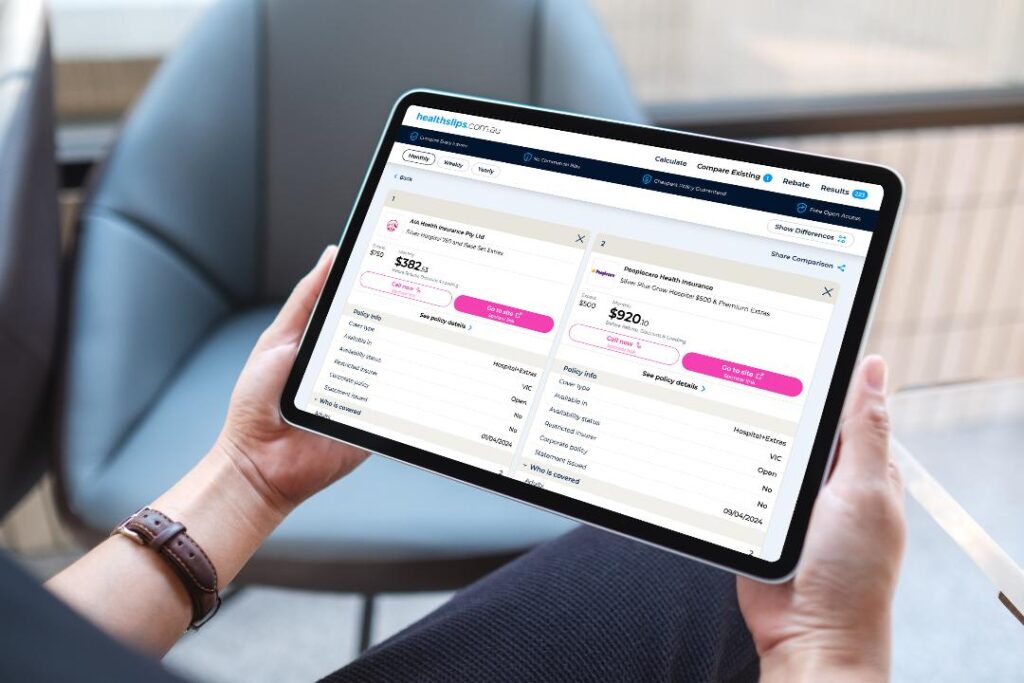
Once you’ve got a good picture of your budget and health needs, it’s time to search for the right policy. At healthslips.com.au, you can compare every policy from every health insurer to find the best value cover, without having to enter any contact details. There’s a massive variation in premium prices – look at how much you could save by using our calculator to change policies:
COUPLES POLICY PRICE COMPARISON
Combined Hospital and Extras Cover in VIC, excess up to $750, including open and restricted insurers
Tier
Cheapest monthly
Expensive monthly
Difference monthly
Difference annually
Basic
$223.85
$608.60
$384.75
$4,617.00
Bronze
$284.10
$727.42
$443.32
$5,319.84
Silver
$376.60
$1,012.04
$635.44
$7,625.28
Gold
$610.60
$1,608.72
$998.12
$11,977.44
Notes: includes restricted and open insurers. Only includes Extras Cover with General Dental, Optical and Physio treatments. Calculations completed April 2026 at healthslips.com.au. May include ‘plus’ policies.
With the healthslips.com.au calculator, you can compare your existing policy against policies for singles, couples or for your entire household (including the kids). You can also compare different levels of cover, such as Gold vs Silver Hospital Cover. It’s the simplest, most accurate way to make a true comparison of health insurance policies out there and find the best fit for you, at the best price.
Trudie McConnochie
Writer and Researcher
Knowledge is power – that’s the guiding principle behind everything Trudie writes, and it’s a philosophy she brings to her work at healthslips.com.au. By breaking down complex information into easy-to-understand blogs and stories, she aims to empower Australians to make the best choices and an informed decision around private health insurance.
Trudie understands firsthand some of the complexity of private health insurance having moved to Australia from New Zealand and having to navigate a vastly different public healthcare system and health insurance structure.
Trudie holds a Bachelor of Communication Studies (journalism major) from the Auckland University of Technology.