healthslips has partnered with ItsMy Group Pty Ltd (ItsMy Group) for the provision of health insurance products. By proceeding, you agree that ItsMy Group will use your personal information to provide advice on health insurance products and assist with arranging cover, and that ItsMy Group and healthslips will collect, store and use your information in accordance with the ItsMy Group Privacy Policy and the healthslips.com.au Privacy Policy. Not all policies can be discussed or purchased over the phone. If ItsMy Group cannot assist with your preferred policy, they will tell you and offer to discuss alternatives or provide you with contact details for your preferred policy.
If you need extra help to navigate challenges in life, seeing a psychologist can be a good source of support. According to ABS data, in 2024-25 17.3% of Australians saw a health professional for mental health, with 8.5% seeing a psychologist. But sessions with a psychologist aren’t cheap, with the Australian Psychological Society suggesting 45-60 minute sessions cost around $330 for 2026-27. If you’re considering starting therapy, your private health insurance might be able to reduce the cost of sessions. You’ll need to have Extras Cover that includes Psychology.
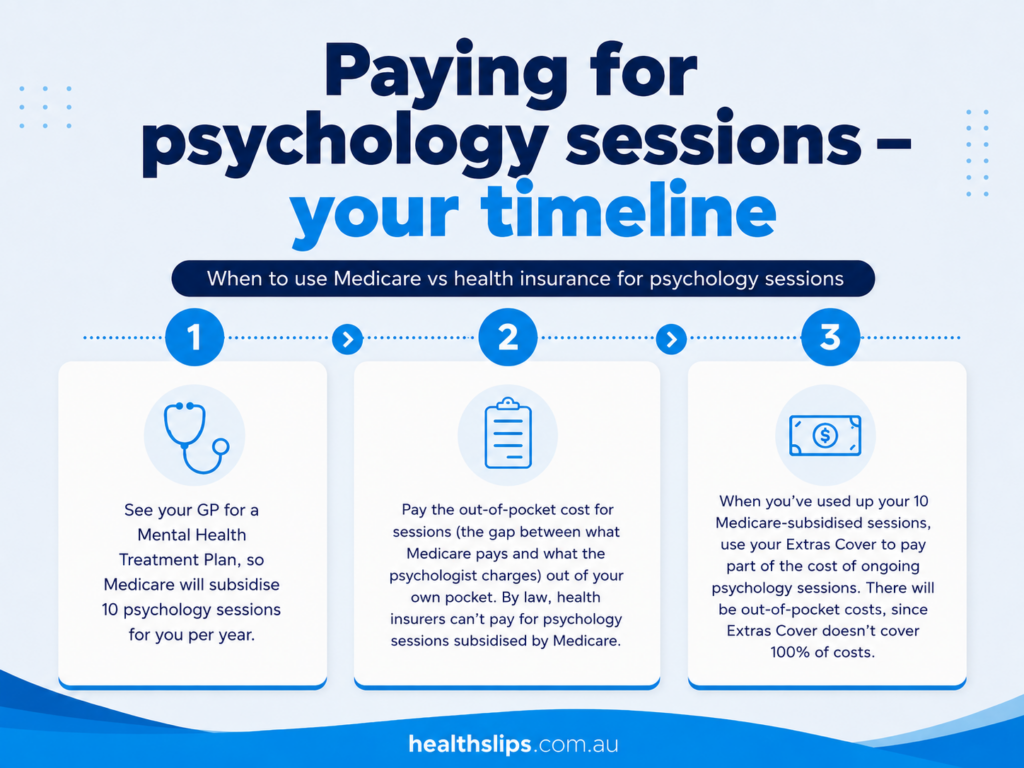
It’s important to know that you can’t use private health insurance for psychology sessions that are subsidised by Medicare. So if you have a Mental Health Treatment Plan, you can only use Extras Cover to pay the out-of-pocket costs after you’ve used up your Medicare-subsidised sessions. This timeline graphic shows you how:
Here are the 3 criteria to check before you claim psychology on private health insurance.
Limits
Extras Cover doesn’t pay the whole cost for your psychology session. Some policies will pay a percentage per appointment, say 50%. Some will pay a set amount per session. And there’s an annual limit – once you hit that, you can’t claim again until your limits reset (usually at the start of the calendar year, but some policies reset at the start of the financial year). Check your policy to see how limits are applied and when they reset.
Waiting periods
Most Extras Cover policies have a waiting period of 2 months for psychology claims on new policies. The good news is that unlike Hospital Cover, you won’t have longer waiting periods for pre-existing conditions on Extras Cover.
Provider requirements
Many health insurers have requirements for the psychologists they’ll accept claims from. Your psychologist will need to be:
A member of a professional organisation
Endorsed by the Psychology Board of Australia
Meet your insurer’s conditions, e.g. being a recognised provider.
Contact your insurer or check your policy to find out if any conditions apply. It’s also a good idea to check with the psychologist about their health insurance payment terms and processes. Some might have HICAPS machines that will process your claim on the spot. Others will issue you a receipt you can use to claim through your insurer’s website or app.
Our expert tips
If you live in a regional area, or the psychologists in your area are booked up, access to a psychologist might be difficult. Most insurers allow you to claim for telehealth sessions, so look for a psychologist who works via telehealth. You can also check whether counselling is a more convenient option. Some insurers allow you to claim for counselling sessions, so contact your insurer to find out if that’s an option.
Is Extras Cover for psychology worth having?
It depends on the policy you choose, how often you see a psychologist and your budget. In general, for an Extras Cover policy to be good value, you need to get back more in claims than you spend in premiums. That might be difficult to do with psychology sessions alone, but if you’re also using your policy to claim on other treatments, such as dental check-ups and physiotherapy, it’s more likely you’ll be getting good value for your premiums.
Our expert insights
We used the healthslips.com.au calculator to search for the best Extras Cover policy that included psychology cover. As of May 2026, the cheapest policy for a single adult in Queensland was $21.49/month, which paid 50% of the session cost but there was an annual limit of $100 – so you’d probably hit your limit in the first session. A better option might be a $34.70/month policy, which paid $50 for the first session and $45 for subsequent appointments, with a $540 annual limit. That policy also covers 18 other treatments, including chiro, optical and physio.
Image credit: Shutterstock
When choosing a policy, we recommend you do the maths to compare your premiums to how much you can get back. A $34.70/month policy will cost you $416.40 a year. If you use up your limits on psychology, you’ll get $540 back a year, leaving you $132 better off. To make sure your Extras Cover policy is worth it, you need to spend less on premiums than you’ll get back in claims.
How to find the best private health insurance for psychology
You can search every policy from every insurer in Australia in minutes, for free, using the healthslips.com.au calculator. All results are listed without commercial bias, and without having to enter your name or contact details. Fast, free and reliable – try the calculator and see how much money you could save.
Health insurance for psychiatric hospitalisation
If you’re experiencing a more serious mental health issue and need psychiatric hospitalisation, you can use your Hospital Cover policy for private treatment if you have a Gold tier policy. If you have a lower tier policy, you can upgrade and get immediate access to psychiatric hospitalisation cover without having to serve waiting periods (an option only available once in your lifetime). Find out more about psychiatric hospitalisation in our blog.
Getting support
If you’re going through tough times, you can contact these support services for free at any time:
Beyond Blue 1300 22 4636
Lifeline 13 11 14
healthslips.com.au does not provide general or personalised advice. Your particular circumstances are likely to impact the accuracy, completeness and relevance of the information or results. Take this into account before making a decision and talk to an expert for financial advice.
Trudie McConnochie
Writer and Researcher
Knowledge is power – that’s the guiding principle behind everything Trudie writes, and it’s a philosophy she brings to her work at healthslips.com.au. By breaking down complex information into easy-to-understand blogs and stories, she aims to empower Australians to make the best choices and an informed decision around private health insurance.
Trudie understands firsthand some of the complexity of private health insurance having moved to Australia from New Zealand and having to navigate a vastly different public healthcare system and health insurance structure.
Trudie holds a Bachelor of Communication Studies (journalism major) from the Auckland University of Technology.