healthslips has partnered with ItsMy Group Pty Ltd (ItsMy Group) for the provision of health insurance products. By proceeding, you agree that ItsMy Group will use your personal information to provide advice on health insurance products and assist with arranging cover, and that ItsMy Group and healthslips will collect, store and use your information in accordance with the ItsMy Group Privacy Policy and the healthslips.com.au Privacy Policy. Not all policies can be discussed or purchased over the phone. If ItsMy Group cannot assist with your preferred policy, they will tell you and offer to discuss alternatives or provide you with contact details for your preferred policy.
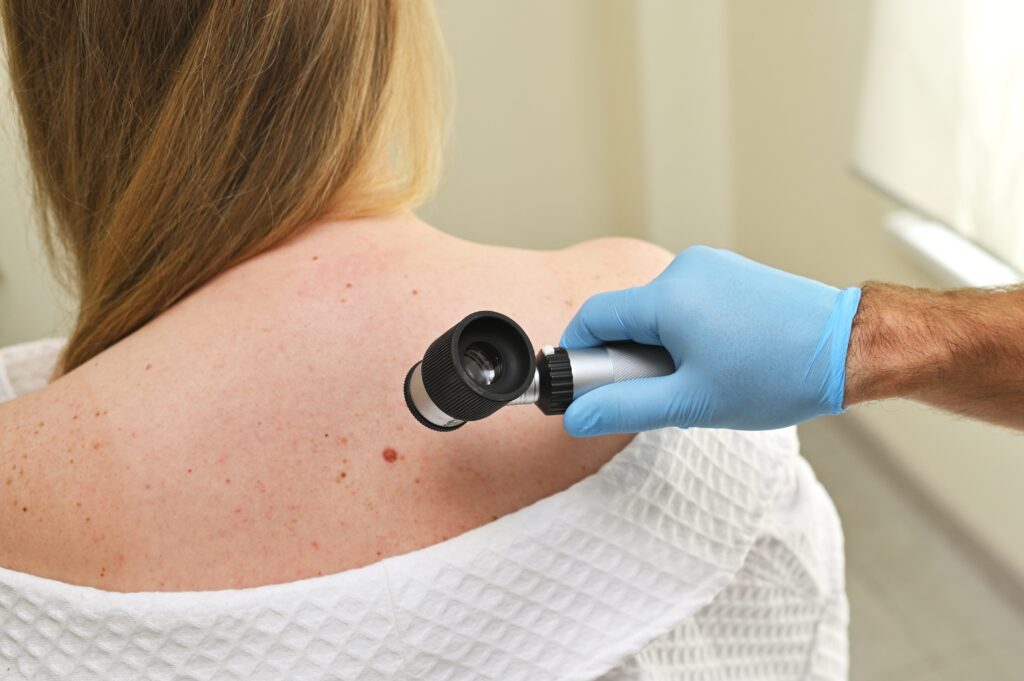
Skin cancer is the most common cancer in Australia, according to the Cancer Council, with more than 2 in 3 of us likely to be diagnosed in our lifetime. One of the most common treatments – including melanoma, basal cell carcinoma and squamous cell carcinoma – is surgical excision to remove the lesion. In fact, based on Medicare data, more than 100 skin cancer treatments for squamous and basal cell carcinoma took place every hour in 2023, on average.
If you want to claim skin cancer surgery on health insurance, you’ll need Hospital Cover with the Skin Conditions clinical category. Here’s your essential 3-step checklist for skin cancer surgery claims on health insurance.
Image credit: Shutterstock
1. Check that you’re covered for skin cancer surgery
If your skin cancer is small and able to be removed in a clinic with local anaesthetic, you can’t claim this on Hospital Cover, because it only applies to in-hospital treatments. By law, health insurers are not allowed to pay for treatments in a GP or specialist’s clinic. You’ll still get a Medicare rebate though – ask the clinic how much Medicare will cover.
If your skin cancer excision is in a private hospital or day hospital, or you’re being treated as a private patient in a public hospital, you may be able to claim on your Hospital Cover. You’ll need Hospital Cover that includes the Skin Conditions clinical category, included on all policies Bronze tier and above. Check to see whether there’s an ‘R’ symbol next to the Skin Conditions category on your policy – if there is, your cover is restricted, which means you’ll face large out-of-pocket costs when you claim. Ask your insurer for details.
2. Confirm the out-of-pocket costs
For private hospital skin cancer surgery, you’ll need to pay the:
Gaps for doctor fees. According to the government’s Medical Costs Finder website, the average Gap for removal of a skin lesion was $500. This can vary by state, with average Gaps in Victoria being $300 while it’s typically around $500 in NSW and Queensland.
Ask your doctor for a full breakdown of costs for all doctors involved, including anaesthetists. Take note of the Medicare Benefit Schedule (MBS) Fee – you can use this to compare costs with other doctors.
The healthslips.com.au team found a handful of Basic Plus policies offering unrestricted cover for Skin Conditions, and they were all priced around the same mark as the cheapest Bronze and Bronze Plus policies. For one adult in Victoria, the cheapest Basic Plus policy was $129.53 per month with a $750 excess, which offered cover for Skin Conditions plus 17/38 more clinical categories. However the cheapest Bronze policy was $130.57, with a $750 excess, covering Skin Conditions plus 21/38 other clinical categories. Depending on your health needs and budget, it might be worth paying a couple of dollars more a month for more extensive cover.
3. Consider changing policies
If your policy doesn’t offer enough cover, or your doctor doesn’t have a Gap cover arrangement with your insurer, consider switching. You can change to a new Hospital Cover policy at the same tier without having to serve waiting periods again, but if you upgrade to a higher tier, you’ll have waiting periods for the clinical categories you weren’t previously covered for. When you change, your insurer will receive a Transfer Certificate (sometimes called a Clearance Certificate) which specifies what you were covered for, what waiting periods you’ve already served, and what government penalties and incentives you’ve been receiving.
Ask your AI to compare the average cost of small skin lesion removals by dermatologists in your area. If you don’t know your MBS Fee for the treatment, ask AI to find it for you, to help you compare clinic charges. For in-hospital skin lesion removals, ask your AI to search for surgeons in your area who have no-Gap or known-Gap agreements with your insurer.
healthslips.com.au does not provide general or personalised advice. Your particular circumstances are likely to impact the accuracy, completeness and relevance of the information or results. Take this into account before making a decision and talk to an expert for financial advice.
Trudie McConnochie
Writer and Researcher
Knowledge is power – that’s the guiding principle behind everything Trudie writes, and it’s a philosophy she brings to her work at healthslips.com.au. By breaking down complex information into easy-to-understand blogs and stories, she aims to empower Australians to make the best choices and an informed decision around private health insurance.
Trudie understands firsthand some of the complexity of private health insurance having moved to Australia from New Zealand and having to navigate a vastly different public healthcare system and health insurance structure.
Trudie holds a Bachelor of Communication Studies (journalism major) from the Auckland University of Technology.