healthslips has partnered with ItsMy Group Pty Ltd (ItsMy Group) for the provision of health insurance products. By proceeding, you agree that ItsMy Group will use your personal information to provide advice on health insurance products and assist with arranging cover, and that ItsMy Group and healthslips will collect, store and use your information in accordance with the ItsMy Group Privacy Policy and the healthslips.com.au Privacy Policy. Not all policies can be discussed or purchased over the phone. If ItsMy Group cannot assist with your preferred policy, they will tell you and offer to discuss alternatives or provide you with contact details for your preferred policy.
When you’re claiming private hospital treatment on Hospital Cover, you probably assume all your costs will be covered – so it can be a bit of a shock to learn you might have to pay a Gap (out-of-pocket costs). Fortunately, health insurance Gap cover schemes – offered by many insurers – can help you reduce or eliminate out-of-pocket costs. Here’s how they work.
Image credit: Shutterstock
Why do Gaps exist?
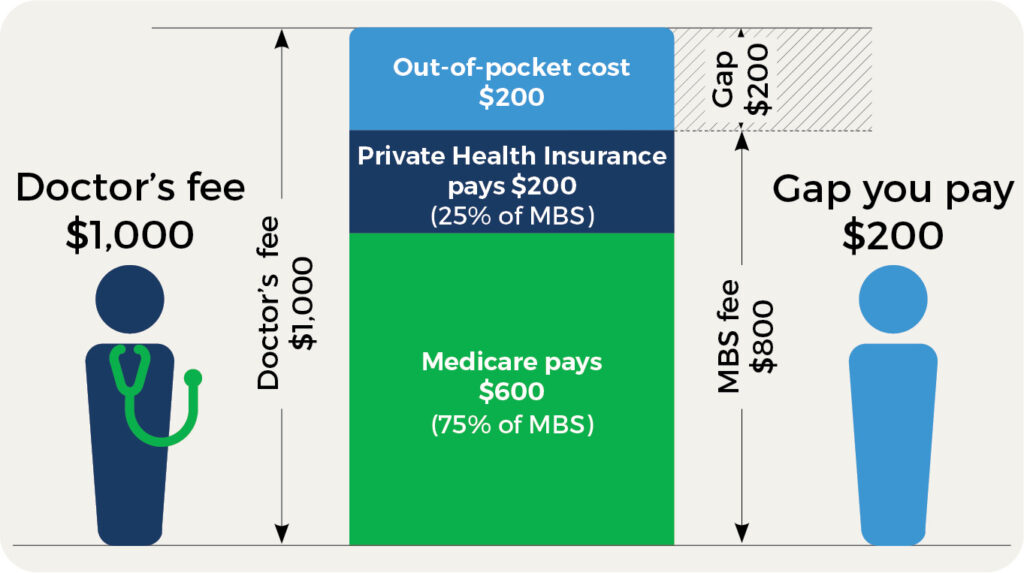
Gaps happen when doctors charge more than the Medicare Benefits Schedule Fee (MBS) set by the government for that procedure. When you have a hospital procedure done as a private patient, Medicare will pay 75% of the MBS Fee amount, and your health insurer pays the remaining 25%. But if your doctor charges more than the MBS Fee amount, the difference is a Gap for you to pay.
There are lots of ways to reduce your Gap, and choosing a doctor who participates in a Gap scheme with your insurer is one of them.
Remember: if you are treated as a public patient in a public hospital, Medicare will pay all of your costs – there won’t be a Gap.
How do health insurance Gap cover schemes work?
A Gap scheme or Gap cover scheme is an agreement between doctors and health insurers stipulating what doctors will charge for certain procedures. Gap schemes mean members of that health insurer will pay a lower Gap, or no Gap, when treated by a participating doctor.
Gap schemes might involve a:
No Gap agreement – where the insurer and doctor have agreed on a set treatment fee which results in no out-of-pocket costs for you.
Known-Gap agreement – where the insurer and doctor have agreed on a set treatment fee which results in a lower Gap for you.
You can find out whether your doctor has a Gap scheme arrangement with your insurer by asking your doctor, contacting your insurer or checking your insurer’s website.
Can Gap schemes save me money on treatments?
Yes, choosing a doctor who participates in a Gap scheme with your health insurer will mean either no Gap, or a lower Gap for your hospital procedure. If your doctor does not have a Gap scheme arrangement with your insurer, you can reduce out-of-pocket costs by changing to a doctor who does. Contact your insurer or check online for a list of doctors participating in your insurer’s Gap scheme.
Essential to know
Doctors aren’t obligated to honour their Gap cover arrangements with insurers. If they choose to charge more for a procedure than what they’ve agreed with your insurer, that will create a higher Gap for you to pay.
How do I know what my Gap will be?
Your doctor will give you a breakdown of costs for your procedure which will specify the Gap involved – this is known as Informed Financial Consent. Make sure it includes fees for all doctors who will be involved in the procedure, such as anaesthetists. This cost breakdown will also include the MBS item number for the procedure, which you can use to compare your Gap with average Gaps for that procedure on the government’s Medical Costs Finder website. You can also ring other doctors in your area and quote the MBS item number to find out what Gap they charge.
Can I change my Hospital Cover policy?
Yes, you can change your Hospital Cover policy at any time, and you won’t have to serve waiting periods again if you’re changing to a Hospital Cover policy at the same tier or lower than your existing policy. The easiest way to compare policies is with the healthslips.com.au calculator which is fast, free and anonymous. You can use it to compare your current policy with every similar policy available in Australia.
healthslips.com.audoes not provide general or personalised advice. Your particular circumstances are likely to impact the accuracy, completeness and relevance of the information or results. Take this into account before making a decision and talk to an expert for financial advice.
Trudie McConnochie
Writer and Researcher
Knowledge is power – that’s the guiding principle behind everything Trudie writes, and it’s a philosophy she brings to her work at healthslips.com.au. By breaking down complex information into easy-to-understand blogs and stories, she aims to empower Australians to make the best choices and an informed decision around private health insurance.
Trudie understands firsthand some of the complexity of private health insurance having moved to Australia from New Zealand and having to navigate a vastly different public healthcare system and health insurance structure.
Trudie holds a Bachelor of Communication Studies (journalism major) from the Auckland University of Technology.